Semantics
John P. McCrae - University of Galway
Course at ESSLLI 2025

Vector space models
Vector space models
Mathematical model for representing text as a vector of numbers.
Enables linear algebra to analyse text.
Term-document matrix
A term-document matrix is a matrix where each row represents a term and each column represents a document.
| Document 1 | Document 2 | Document 3 | |
| Term 1 | 1 | 0 | 1 |
| Term 2 | 0 | 1 | 1 |
| Term 3 | 1 | 1 | 0 |
Term-document matrix
Python example
term_document_matrix = np.zeros((len(vocabulary), len(documents)))
for doc in documents:
    for term in doc:
      term_document_matrix[term][doc] += 1
Similarity measures
Cosine similarity (angle between vectors)
Euclidean distance (distance between vectors)
from sklearn.metrics.pairwise import (cosine_similarity,
  euclidean_distance)

cosine_similarity(term_document_matrix[0],
                  term_document_matrix[1])
euclidean_distance(term_document_matrix[0],
                   term_document_matrix[1])
Term-document matrix
Very large
Very sparse (many zeros)
Not very informative
Hands-on: Vector space models
Word embeddings
Word embeddings
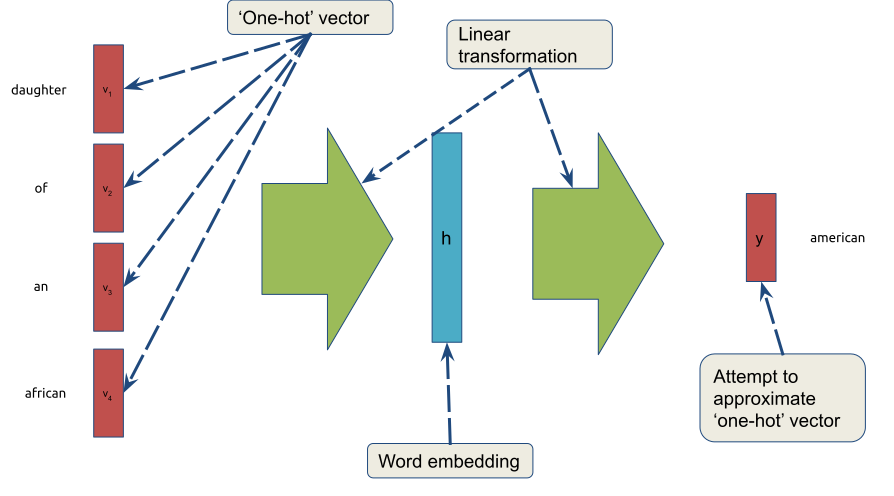
Instead of a large vector compress all this information into a small vector.

Word embeddings - Autoencoders

Word embeddings - Word2Vec
Analogy
Word vectors capture linguistic regularities
vec(Berlin) ≃ vec(Germany) + vec(Paris) - vec(France)

Understanding semantic spaces
Loading word embeddings
We will use the GloVe vectors
from gensim.models import KeyedVectors
glove = KeyedVectors.load_word2vec_format('glove.6B.50d.txt',
                            binary=False, no_header=True)
Most similar words
glove.most_similar("belgium")
[('netherlands', 0.8926310539245605),
('france', 0.8631513118743896),
('switzerland', 0.8280506134033203),
('austria', 0.8187914490699768),
('luxembourg', 0.8173472285270691)]
Analogy
def analogy(x1, x2, y1):
  result = glove.most_similar(positive=[y1, x2],
                              negative=[x1])
  return result[0][0]
PCA and t-SNE
- Word embeddings have many dimensions
- Reduce to 2 dimensions to visualise
- Principal Component Analysis (PCA) - linear
- t-distributed Stochastic Neighbour Embedding (t-SNE) - non-linear
Visualisation with PCA

Hands-on: Word embeddings
Pretrained language models
Language Models
A language model is a function that calculates the likelihood of a string of words.
P("this string") = 0.0001
What's the big deal???
The probability of text is higher if the text is:
- In a language
- Grammatically order
- Coherent
- Plausible
Generative Language Models
Languages models can generate text
\[ \max_{w \in \mathrm{vocabulary}} p(\mathrm{what~is~the~next~} w)\]
Repeating this allows us to generate text
Pretraining
Most models are trained autoregressively
Can you guess the word?
- for the humanities, literature and culture in the ????
- the theme of the album is the life of the ???
- shipping in the caribbean and off the ???
- she was the daughter of an african ???
Transformers
- Most popular architecture at the moment
- Why transformers?
- Natural language is hard to do math with:
- Words not numbers
- Sentences of different lengths
Transformers

ChatGPT
Generative Pre-Trained Transfomer
Prompt Engineering
Prompt Engineering
- Large (>10B parameter) models demonstrate emergent properties
- Using the correct initial text (prompt) we can extra information from the language model
- Huggingface Hub
Zero-shot prompting
Input:
Classify the text into neutral, negative or positive.
Text: I think the vacation is okay.
Sentiment:
Output:
positive
Few-shot prompting
Input:
Classify the text into neutral, negative or positive.
Text: I think the vacation is okay.
Sentiment: neutral
Text: I think the vacation is great.
Sentiment: positive
Text: I think the vacation is terrible.
Sentiment: negative
Text: I think the vacation is okay.
Sentiment:
Output:
neutral
Chain-of-thought prompting
Input:
Sarah has 3 packs of pencils. Each pack contains 5 pencils.
How many pencils does she have in total?
Output:
<think>Each pack has 5 pencils, and there are 3 packs.
Multiplying 3 × 5 gives the total number of pencils.</think>
15 pencils
Self-evaluation
Input:
is 9 + 10?
Output:
21
Input:
What is 9 + 10?
21
Do you think 21 is the correct answer?
Output:
No
Hands-on: Word Sense Induction
Summary
Summary
- Vectors allow us to do maths with language
- Word embeddings reveal hidden semantic relations
- Large language models show (astonishing) ability to generate plausible dialogue